
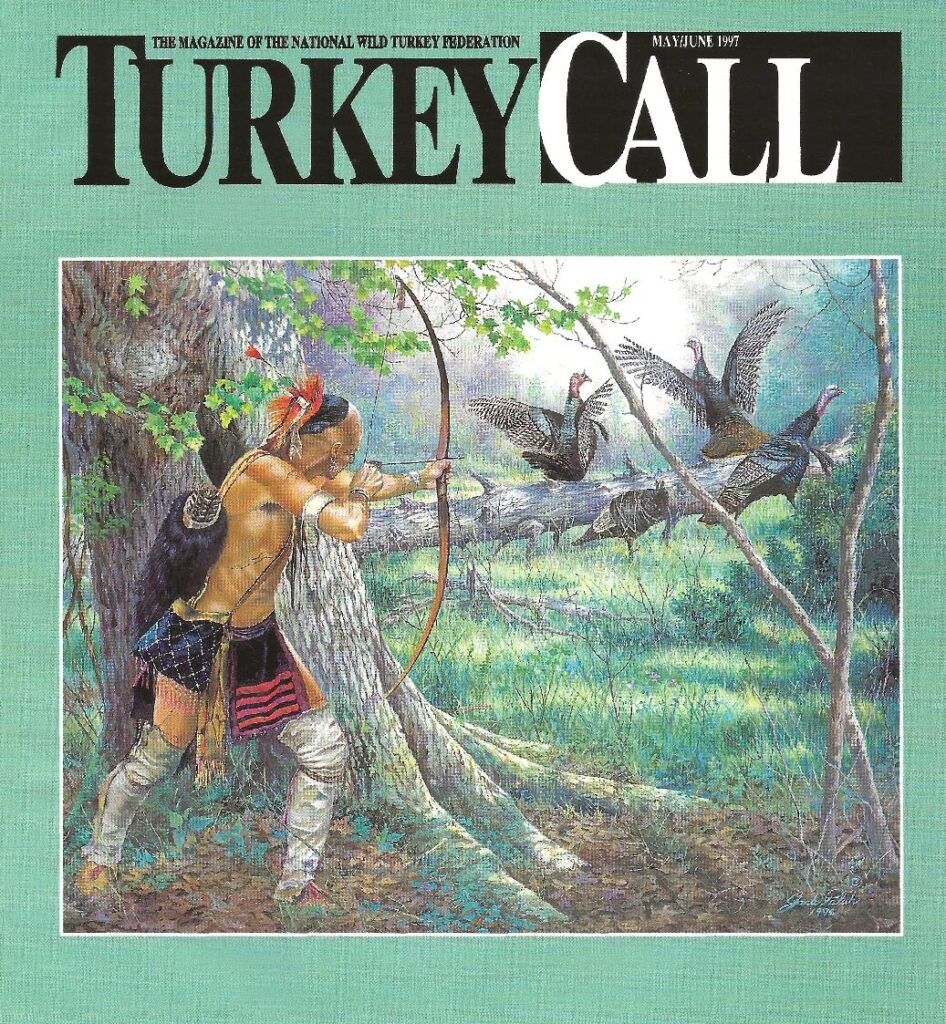
The phrase, “he came like he was on a string,” is often used by turkey hunters who have experienced textbook hunts where a gobbler promptly answers their calls, marches right in without hesitation and catches a head full of lead. After going several rounds with a pair of Missouri longbeards, I wasn’t sure who had who. The duo had kept up an hour-long, tag-team match of wits—yo-yoing back and forth on the edge of gun range that was giving me a case of mental whiplash.

I had often marveled at the tales of limbhanger-sized longbeards from the Show-Me State. Early in his career, Tennessee call maker Roy Rhodes ventured to this land of giants and brought back a tale of a hunt that evoked images of gobbling ostriches. One 28½-pound Missouri brute sticks in my mind. It would be several years, but I knew that someday I would get my chance to hunt these gorilla gobblers.
My invitation came from Winchester Ammunition expert Mike Jordan and Timber Ghost Camouflage’s Kevin Carlisle. They put together a hunt in a truly special place near Rolla, Missouri—on a farm that is the site of Missouri’s earliest turkey trapping for restoration purposes and a pre-historic Native American village. It was exciting to hear that the gobblers there were descendants of Missouri’s seed stock, as well as the ultimate source of many other states’ wild turkey restorations. It was a splendid chance to hunt all day—turkeys in the morning and Indian artifacts in the afternoons.

The Hunt
After the first day running the ridges with my guide, Danny Miller, a cartographer for the U.S. Geological Survey’s office in Rolla, we returned to what is locally referred to as Indian Hill to listen for a gobbler’s wake-up call.
(Editor’s Note: All these years later, Danny is a Missouri Land Company agent.)
Hiking up a deer trail toward the top before dawn, we were stopped mid-step by a roosted bird close at hand. Once on top, I eased closer to the bird, leaving Danny about 40 yards behind to cover the back door. I chose a spot 35 yards back from where the hill dropped off sharply. My position faced slightly to the right of the direction of the bird roosted halfway down the hill. A few moments later, another mature bird sounded off further down the hill, which enticed a third bird—a jake—to put in his two cents.
When I thought 10 minutes had passed, I stroked a slate and whispered a few tree calls. Immediately, all three birds hammered the hen talk. As gray gave way to pink and orange celestial hues, other more distant toms added to the spring chorus. More hen talk, and we felt it. I pulled my cap off my head and slapped the leaves beside me and gave a short fly-down cackle. One bird pitched off and I felt right, I pulled my cap off my head and slapped the leaves beside me and gave a short fly-down cackle. One bird pitched off down the hill, cutting the leaves beside me and slapped the leaves beside me and gave a short fly-down cackle. The birds below gobbled back and kept up the din spurred on by each other’s calls. After about a minute the two birds gave up their shouting match with each other and sailed from their perch.
Yelping on the slate helped me keep track of their advance up the steep hill. As the birds approached, they angled to my right around the point I had set up on. Craning my neck, I tried to listen for approaching footsteps. Both birds dropped lower on the hill, so I twisted to face their last calls. Things tightened fast. The white oak I was set up against was too large in diameter to allow a clean pivot, so I had to scoot all the way around it, ending up in a half-seated, awkward position with my right shoulder resting against the trunk.
Try to picture what happened next. I typically sit reclined, knees up, shotgun resting across my left knee—this keeps the gun shouldered and level. Suddenly, the birds’ fans appeared over the ridge about 35 yards out and continued their march in my direction. Just as they were about to crest, my right shoulder slipped off the tree and I began sliding backward until I was flat on my back.
It wasn’t funny then—but it is now.
The Yo-Yo Begins
I had to slide lower to keep the shotgun pointed in their direction. By this time, I had quit calling and hoped the birds would walk off so I could reposition. Danny, who had a ringside seat, thought he could help by scratching in the leaves like a hen to draw them closer.
After about five minutes in that half-sit position, the birds still hadn’t moved to a spot where I could shoot. Thankfully, they drifted back down the hill, allowing me to reset. I started calling again, and they answered every yelp.
For the next 15 minutes, they worked left under the hill until I was in the same predicament—180 degrees from where they had been earlier. You can guess what happened next. My left shoulder slid off the tree and I did another 10-minute abdominal crunch. Once again, my hunting partner tried to help me out by scratching in the leaves when I quit calling.
I was pinned down, couldn’t move, and those two longbeards stood at 30 yards, gobbling their brains out.
Mercifully, they walked off again.
Closing the Deal

As soon as I got situated, I immediately hammered them with a non-stop symphony of cuts, yelps, and purrs. This time, I was ready.
I could hear them drumming straight ahead. Their fans came into view for the third time, and I cutt again. They gobbled in unison, folded their fans, lowered their heads, and began that oblivious swagger walk that every turkey hunter loves to watch.
When the twins stopped at 15 yards to survey the hilltop, I picked one out and let the fire behind a 2-ounce load of Winchester No. 5s do the rest.
After the Shot
Although the plump 2-year-old tom sported a 9¼-inch beard and weighed 20 pounds, he gave me a grand experience that I’ll cherish for years to come. And next time I hear another hunter say he had a gobbler “on a string,” I’ll remember the Yo-Yo gobblers of Indian Hill.
Discover more from ShootingSavvy.com
Subscribe to get the latest posts sent to your email.